1. There are 1500 pupils in upper primary in ABC school. 1/4 of the boys and 2/3 of the girls are in lower primary. 60% of the upper primary pupils are boys while the rest are the upper primary girls.
(a) What is the ratio of the total no. of boys to the total no. of girls in the school? (Express your answer in the simplest form)
(b) 900 girls in the lower primary do not wear spectacles. Of all the lower primary pupils, what is the percentage of girls who wears spectacles?
2. Peter has $8 more than Ben. Then, Peter gave 1/4 of his money to Ben. As a result, the ratio of the amount of money Peter had to the amount of money Ben became 5:7. How much money did Peter give to Ben?
3. Harry spent 1/2 of his money on some muffins and 3/5 of his remaining money on 5 pieces of cakes. Each piece of cake cost thrice as much as muffins. How many muffins did he buy?
4. The ratio of Xavier’s savings to Henry’s savings was 6:7.
Xavier and Henry shared the cost of a game set in the ratio 4:5 respectively
Xavier used 2/3 of his saving to pay for his share of the game set. Henry was left with $150 after paying for his share.
a) What was Henry's saving’s before paying for his share of the game set?
b) What was the cost of the game set?
5. There are 160 red marbles and some blue marbles in a box. If 3/8 of the blue marbles is taken out of the box and 50 new red marbles are put into the box, the ratio of the number of red marbles to the number of
blue marbles becomes 7:9. How many blue marbles are there in the box?
*6. A boutique owner bought 1.5 times as many skirts as dresses. She spent $1496 altogether. A dress costs $4 more than a skirt. The total cost of the skirts was $136 more than the total cost of the dresses. Find the cost of 2 skirts and 1 dress.
Friday, July 23, 2010

iMaths Practise 2 Solution
Q1. Case 1
X = unit + 30
Y = unit - 30
Case 2
X = unit + 30 + 18
Y = unit - 30 - 18
unit+30+18 = 4(unit-30-18)
unit+48 = 4units-192
3 units = 240
1 unit = 80
At first, X = unit+30 = 80+30=110
At first,number of beads in Box X was 110.
Q2. In the end, all 3 containers became equal.
So, P=Q=E = 162 divided by 3 = 54
R(Original) = 54 divided by 3 = 18
Q(Before giving R and after receiving from P)= 54+18x2 = 90
Q(Original) = 90 divided by 3 = 30
P(Original) = 54+30x2 = 114
Number of buttons in container P at first = 114.
Q3. In the end,
X = 115
Y = 90
2/3 of Y = 90
Y = 135
X = 115-(90÷2)=70
2/3 of X = 70
X = 70x3/2= 105
Y = 135-(70÷2) = 100
4/5 of Y = 100
Y = 125
X = 105-(100÷4) = 80
AT first, there were 80 marbles in Box X and 125 marbles in Box Y.
Q4. (7+½)x2=15
(15÷2)+½ = 8
Number of chocolate bars that the third child got = 8.
Note
1st child got 32 chocolate bars
2nd child got 16 chocolate bars
3rd child got 8 chocolate bars
4th child got 7 chocolate bars
Total = 63 chocolate bars.
Q5. Women = 1/5
Men + Children = 4/5
Men = 2/5x4/5 = 8/25
Children = 1-1/5-8/25 = 12/25
12/25 of total = 266+266x2 = 798
8/25 of total = 532
Number of men in the hall = 532.
Q6. Cloths = 5/9
Gifts = 1/3
Mother + Left = 1-5/9-1/3 = 1/9
1/9 of the total = $1500+$560 = $2060
Total for Samuel= $2060x9 = $18540
Total for Samuel and Nigel = ($18540/4)x9 = $41715
Q7. 3N + J = 40.80
2N + 2J = 45.20 (86 - 40.80)
J - N = 4.4
Rewriting N as J -4.4
3J - 13.20 + J = 40.80, J = 54/3 = 13.50
Q8. 0.7 blue + 0.7 red --> 91 (adding both)
7 blue + 7 red --> 910 (times by 10)
1 blue + 1 red --> 130 (divide by 7)
X = unit + 30
Y = unit - 30
Case 2
X = unit + 30 + 18
Y = unit - 30 - 18
unit+30+18 = 4(unit-30-18)
unit+48 = 4units-192
3 units = 240
1 unit = 80
At first, X = unit+30 = 80+30=110
At first,number of beads in Box X was 110.
Q2. In the end, all 3 containers became equal.
So, P=Q=E = 162 divided by 3 = 54
R(Original) = 54 divided by 3 = 18
Q(Before giving R and after receiving from P)= 54+18x2 = 90
Q(Original) = 90 divided by 3 = 30
P(Original) = 54+30x2 = 114
Number of buttons in container P at first = 114.
Q3. In the end,
X = 115
Y = 90
2/3 of Y = 90
Y = 135
X = 115-(90÷2)=70
2/3 of X = 70
X = 70x3/2= 105
Y = 135-(70÷2) = 100
4/5 of Y = 100
Y = 125
X = 105-(100÷4) = 80
AT first, there were 80 marbles in Box X and 125 marbles in Box Y.
Q4. (7+½)x2=15
(15÷2)+½ = 8
Number of chocolate bars that the third child got = 8.
Note
1st child got 32 chocolate bars
2nd child got 16 chocolate bars
3rd child got 8 chocolate bars
4th child got 7 chocolate bars
Total = 63 chocolate bars.
Q5. Women = 1/5
Men + Children = 4/5
Men = 2/5x4/5 = 8/25
Children = 1-1/5-8/25 = 12/25
12/25 of total = 266+266x2 = 798
8/25 of total = 532
Number of men in the hall = 532.
Q6. Cloths = 5/9
Gifts = 1/3
Mother + Left = 1-5/9-1/3 = 1/9
1/9 of the total = $1500+$560 = $2060
Total for Samuel= $2060x9 = $18540
Total for Samuel and Nigel = ($18540/4)x9 = $41715
Q7. 3N + J = 40.80
2N + 2J = 45.20 (86 - 40.80)
J - N = 4.4
Rewriting N as J -4.4
3J - 13.20 + J = 40.80, J = 54/3 = 13.50
Q8. 0.7 blue + 0.7 red --> 91 (adding both)
7 blue + 7 red --> 910 (times by 10)
1 blue + 1 red --> 130 (divide by 7)
Thursday, June 3, 2010
P5 - i-Maths Practise 2
1. 2 boxes X and Y, contained some beads. If 30 beads were transferred from Box X to Box Y, both boxes would have the same number of beads. If 18 beads were transferred from Box Y to Box X, Box X would have 4 times as many beads as Box Y. How many beads were there in Box X at first?
2. 3 containers P,Q and R had 162 buttons altogether. Some buttons were transferred from container P to container Q and the number of buttons in container Q becomes thrice its original number. Then some buttons were transferred fron container Q to container R and the number of buttons in container R becomes thrice its original number. As a result, the number of buttons in the 3 containers became equal. How many buttons were there in container P at first?
3. There were some marbles in X and Y. 1/5 of the marbles in Box Y were transferred to Box X. Then 1/3 of the marbles in Box X were transferred to Box Y. Finally, 1/3 of the marbles in Box Y were transferred to Box X. As a result, there were 115 marbles in Box X and 90 marbles in Box Y. How many marbles were in each box at first?
4. 4 children share a box of chocolate bars. The first child took 1/2 of the total bars of chocolate and 1/2 of a chocolate bar. The second child took 1/2 of the remaining bars and 1/2 of a chocolate bar. The third child took 1/2 of the remaining bars and 1/2 of a chocolate bar. The fourth child took the remaining 7 bars. How many bars of chocolate did the third child get?
5. 1/5 of the audience in a hall are women. 2/5 of the remaining audience are men. The rest are children. If there are 266 boys in the hall and the number of girls is twice as many as the number of boys, find the number of men in the hall.
6. The original amount of money Samuel had to the original amount of money Nigel had was 4:5.
After Samuel spent 5/9 of his money on clothing, 1/3 of it on gifts and gave $1500 to his mother, he had $560 left. What was the total amount of money both men had originally?
7. Nasir and Janice shared $86 .When Nasir spent 3/5 of his money and Janice spent 1/3 of her money,they spent $40.80 altogether.What was the sum of money that Janice received?
8. 0.2 of the blue caps and 0.5 of the red caps is equal to 38.
0.5 of the blue caps and 0.2 of the red caps is equal to 53.
What is the total number of blue and red caps?
2. 3 containers P,Q and R had 162 buttons altogether. Some buttons were transferred from container P to container Q and the number of buttons in container Q becomes thrice its original number. Then some buttons were transferred fron container Q to container R and the number of buttons in container R becomes thrice its original number. As a result, the number of buttons in the 3 containers became equal. How many buttons were there in container P at first?
3. There were some marbles in X and Y. 1/5 of the marbles in Box Y were transferred to Box X. Then 1/3 of the marbles in Box X were transferred to Box Y. Finally, 1/3 of the marbles in Box Y were transferred to Box X. As a result, there were 115 marbles in Box X and 90 marbles in Box Y. How many marbles were in each box at first?
4. 4 children share a box of chocolate bars. The first child took 1/2 of the total bars of chocolate and 1/2 of a chocolate bar. The second child took 1/2 of the remaining bars and 1/2 of a chocolate bar. The third child took 1/2 of the remaining bars and 1/2 of a chocolate bar. The fourth child took the remaining 7 bars. How many bars of chocolate did the third child get?
5. 1/5 of the audience in a hall are women. 2/5 of the remaining audience are men. The rest are children. If there are 266 boys in the hall and the number of girls is twice as many as the number of boys, find the number of men in the hall.
6. The original amount of money Samuel had to the original amount of money Nigel had was 4:5.
After Samuel spent 5/9 of his money on clothing, 1/3 of it on gifts and gave $1500 to his mother, he had $560 left. What was the total amount of money both men had originally?
7. Nasir and Janice shared $86 .When Nasir spent 3/5 of his money and Janice spent 1/3 of her money,they spent $40.80 altogether.What was the sum of money that Janice received?
8. 0.2 of the blue caps and 0.5 of the red caps is equal to 38.
0.5 of the blue caps and 0.2 of the red caps is equal to 53.
What is the total number of blue and red caps?

Wednesday, May 26, 2010
P5 - i-Maths Practice 1
1. Kathy and Diana read a total of 30 books in January. In February, Kathy read 9 books fewer than Diana who had read thrice as many as she did in January. If both of them read a total of 45 books in February, how many books did Kathy read in the 2 months?
2. Paul has some 10-cent coins and 50-cent coins. The coins add up to $10.70. If there are five more 10-cent coins than 50-cent coins, how many 10-cent coins are there?
3. There are some $5 and $2 notes in a wallet. There are 9 more $2 notes than $5 notes in the wallet. The total value of the money in the wallet is $186. What is the difference in the total amount between the $2 notes and the $5 notes?
*4. Mrs Li had some 50-cent coins and 20-cent coins in a purse. She counted 12 more 50-cent coins than 20-cent coins and the total value of 50-cent coins is $21 more than the total value of 20-cent coins.
a) How many 50-cent coins were there in the purse?
b) What was the total value of the 50-cent coins in the purse?
5. Ben has four time as many stamps as Calvin. How many stamps must Ben give to Calvin so that they each will have 130 stamps.
6. Mr Chng bought a box of pens. 1/5 of the pens were red pens and the rest were black pens. He gave away 1/2 of the red pens and 3/8 of the black pens and had 168 pens left. How many black pens were there in the box at first?
7. Mrs Priya had some buttons. She bought another 143 buttons. She divided all the buttons equally into 8 boxes. She then used 228 buttons for some blouses and gave away 1 box of buttons. If she had 409 buttons left, how many buttons did she have at first?
8. Timothy had some marbles. He gave ½ of them to Jerry and 1/8 of the remainder to Austin. His father gave him 144 marbles and then he had as many marble as he had at first. How many marbles did he have at first?
9. Jane and her friends went to a restaurant for a buffet dinner. The charge for the buffet was $24 per person and 1person dines free for every 4 paying persons. How many people were there if they paid $408 altogether?
10. The total cost of 9 similar bags and 12 similar books is $108. The total cost of 4 such bags and 4 such books is $44. Find the difference between the cost of a bag and a book?
2. Paul has some 10-cent coins and 50-cent coins. The coins add up to $10.70. If there are five more 10-cent coins than 50-cent coins, how many 10-cent coins are there?
3. There are some $5 and $2 notes in a wallet. There are 9 more $2 notes than $5 notes in the wallet. The total value of the money in the wallet is $186. What is the difference in the total amount between the $2 notes and the $5 notes?
*4. Mrs Li had some 50-cent coins and 20-cent coins in a purse. She counted 12 more 50-cent coins than 20-cent coins and the total value of 50-cent coins is $21 more than the total value of 20-cent coins.
a) How many 50-cent coins were there in the purse?
b) What was the total value of the 50-cent coins in the purse?
5. Ben has four time as many stamps as Calvin. How many stamps must Ben give to Calvin so that they each will have 130 stamps.
6. Mr Chng bought a box of pens. 1/5 of the pens were red pens and the rest were black pens. He gave away 1/2 of the red pens and 3/8 of the black pens and had 168 pens left. How many black pens were there in the box at first?
7. Mrs Priya had some buttons. She bought another 143 buttons. She divided all the buttons equally into 8 boxes. She then used 228 buttons for some blouses and gave away 1 box of buttons. If she had 409 buttons left, how many buttons did she have at first?
8. Timothy had some marbles. He gave ½ of them to Jerry and 1/8 of the remainder to Austin. His father gave him 144 marbles and then he had as many marble as he had at first. How many marbles did he have at first?
9. Jane and her friends went to a restaurant for a buffet dinner. The charge for the buffet was $24 per person and 1person dines free for every 4 paying persons. How many people were there if they paid $408 altogether?
10. The total cost of 9 similar bags and 12 similar books is $108. The total cost of 4 such bags and 4 such books is $44. Find the difference between the cost of a bag and a book?
Friday, October 23, 2009
Term 4 - Final Revision_ Fraction
Fraction – Skill required
· Addition and subtraction of like and unlike fractions
· Recognising mixed numbers and improper fractions and able to convert improper fractions to mixed numbers and vice versa.
· Understanding fractions of a set ( Multiplying whole numbers by fractions.
· Solving word problems involving fractions involving adding, subtracting and multiplying.
Problem Solving
1. A florist had some roses in her shop. 1/6 of the roses were sold in the morning and 1/3 of them sold in the afternoon. If 66 roses were left, how many roses were in the shop at first?
2. Kumar has 7/11 as many stamps as Ali. If Ali gives Kumar 18 stamps, both of them will have an equal number of stamps. How many stamps do they have altogether?
3. Mr Lim had 16 guppies. He gave 3/8 of them to his daughter.
a. What fraction of the fish had he left?
b. How many guppies had he left?
4. Mandy had 3/7 of the number of beads that Jenny had at first. When Mandy received 22 beads from Jenny, both of them would have an equal number of beads.
a. How many more beads did Jenny have than Mandy at first?
b. How many beads did they have altogether?
5. James had a certain number of bookmarks. He gave ¾ of the bookmarks to his brother. James and Benny then shared the remaining number of bookmarks equally. Given that James had 46 bookmarks at the end, how many bookmarks did he have at first?
6. Jon bought 3 identical shirts and 4 identical belts for $130. If each belt cost 1/3 as much as a shirt, find the cost of a shirt.
7. Mary has 1/9 as many paper clips as John. John has 144 paper clips more than Mary. How many paper clips must John give Mary so that they will have the same number of paper clips?
8. 3/8 of the pupils in a class like English. 3/5 of the remaining pupils like Maths and the rest like Science. If 9 pupils like Science, how many pupils are there in the class?
9. There are 240 flowers in a garden. 1/5 of the flowers are daisies and 3/8 of the flowers are tulips. The rest are sunflowers. If 1/3 of the daisies and 5/6 of the tulips are removed, how many flowers will be left in the garden?
10. 2/5 of the colored paper in the packet are yellow. 0.5 of them are purple. The remaining ones are green. If there are 60 fewer green colored paper than the purple ones, how many colored paper does the packet contain altogether?
11. A baker sold 2/3 of his breads in the morning. He sold 1/6 of them in the afternoon. He sold 200 breads altogether. How many breads had he left?
12. Stick A is 9cm longer than Stick B. 2/3 the length of Stick B is equal to half the length of Stick A. What is the length of Stick B
13. A tank is 1/3 full. After 6 litres of water was added into the tank, it was 7/12 full. Find the capacity of the tank.
14. A tank was 1/10 full of water. After 35 litres of water were added into the tank, it became 3/5 full. How much water was needed to fill up the 2 full tank?
15. Betty had $320 at first. She spent 5/8 of her money at the bookshop and ¼ of it at the supermarket.
a. What fraction of her money was spent?
b. How much had she left?
16. Susie collected 378 beads. 5/9 of them are green and the rest are red and yellow beads. The number of the red beads is thrice as many as the yellow beads.
a. How many more green beads than yellow beads are there?
b. How many red beads should Susie buy so that the number of red beads would be the same as the green beads?
17. Angie, Betty and Cally had $655 altogether. Angie spent 1/3 of her money. Betty spent $25 and Cally spent twice the amount Angie spent. If they had the same amount of money left, how much money did Cally have at first?
18. Some students were given funfair tickets to sell. ½ of them sold their tickets on Monday. 2/5 of the remaining students sold their tickets on Tuesday. The rest of the students sold their tickets on Wednesday. Given that 108 students sold their tickets on Wednesday and each student sold two tickets, how many tickets were sold altogether?
19. Ben has 2/3 as many stickers as Andy. Kyle has 1/6 as many stickers as Ben. If they have 96 stickers in all, how many more stickers does Ben have than Kyle?
20. Ben has $175 more than Calvin. If Calvin has 2/5 as much money as Ben, how much do they have altogether?
· Addition and subtraction of like and unlike fractions
· Recognising mixed numbers and improper fractions and able to convert improper fractions to mixed numbers and vice versa.
· Understanding fractions of a set ( Multiplying whole numbers by fractions.
· Solving word problems involving fractions involving adding, subtracting and multiplying.
Problem Solving
1. A florist had some roses in her shop. 1/6 of the roses were sold in the morning and 1/3 of them sold in the afternoon. If 66 roses were left, how many roses were in the shop at first?
2. Kumar has 7/11 as many stamps as Ali. If Ali gives Kumar 18 stamps, both of them will have an equal number of stamps. How many stamps do they have altogether?
3. Mr Lim had 16 guppies. He gave 3/8 of them to his daughter.
a. What fraction of the fish had he left?
b. How many guppies had he left?
4. Mandy had 3/7 of the number of beads that Jenny had at first. When Mandy received 22 beads from Jenny, both of them would have an equal number of beads.
a. How many more beads did Jenny have than Mandy at first?
b. How many beads did they have altogether?
5. James had a certain number of bookmarks. He gave ¾ of the bookmarks to his brother. James and Benny then shared the remaining number of bookmarks equally. Given that James had 46 bookmarks at the end, how many bookmarks did he have at first?
6. Jon bought 3 identical shirts and 4 identical belts for $130. If each belt cost 1/3 as much as a shirt, find the cost of a shirt.
7. Mary has 1/9 as many paper clips as John. John has 144 paper clips more than Mary. How many paper clips must John give Mary so that they will have the same number of paper clips?
8. 3/8 of the pupils in a class like English. 3/5 of the remaining pupils like Maths and the rest like Science. If 9 pupils like Science, how many pupils are there in the class?
9. There are 240 flowers in a garden. 1/5 of the flowers are daisies and 3/8 of the flowers are tulips. The rest are sunflowers. If 1/3 of the daisies and 5/6 of the tulips are removed, how many flowers will be left in the garden?
10. 2/5 of the colored paper in the packet are yellow. 0.5 of them are purple. The remaining ones are green. If there are 60 fewer green colored paper than the purple ones, how many colored paper does the packet contain altogether?
11. A baker sold 2/3 of his breads in the morning. He sold 1/6 of them in the afternoon. He sold 200 breads altogether. How many breads had he left?
12. Stick A is 9cm longer than Stick B. 2/3 the length of Stick B is equal to half the length of Stick A. What is the length of Stick B
13. A tank is 1/3 full. After 6 litres of water was added into the tank, it was 7/12 full. Find the capacity of the tank.
14. A tank was 1/10 full of water. After 35 litres of water were added into the tank, it became 3/5 full. How much water was needed to fill up the 2 full tank?
15. Betty had $320 at first. She spent 5/8 of her money at the bookshop and ¼ of it at the supermarket.
a. What fraction of her money was spent?
b. How much had she left?
16. Susie collected 378 beads. 5/9 of them are green and the rest are red and yellow beads. The number of the red beads is thrice as many as the yellow beads.
a. How many more green beads than yellow beads are there?
b. How many red beads should Susie buy so that the number of red beads would be the same as the green beads?
17. Angie, Betty and Cally had $655 altogether. Angie spent 1/3 of her money. Betty spent $25 and Cally spent twice the amount Angie spent. If they had the same amount of money left, how much money did Cally have at first?
18. Some students were given funfair tickets to sell. ½ of them sold their tickets on Monday. 2/5 of the remaining students sold their tickets on Tuesday. The rest of the students sold their tickets on Wednesday. Given that 108 students sold their tickets on Wednesday and each student sold two tickets, how many tickets were sold altogether?
19. Ben has 2/3 as many stickers as Andy. Kyle has 1/6 as many stickers as Ben. If they have 96 stickers in all, how many more stickers does Ben have than Kyle?
20. Ben has $175 more than Calvin. If Calvin has 2/5 as much money as Ben, how much do they have altogether?
Wednesday, September 30, 2009
Term 4 – Problem Solving Practice 3
(Pattern Problems – use a table to identify pattern fundamental so as to predict what will come next and what will happen again and again in the same way
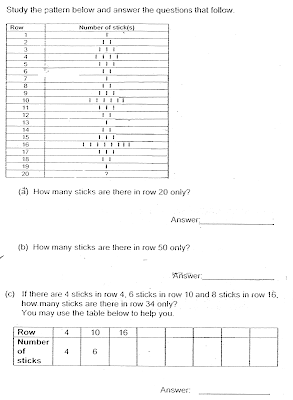
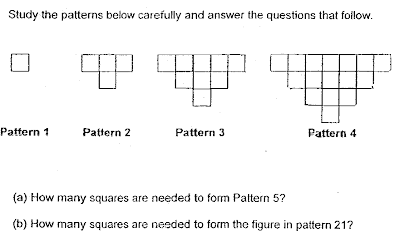
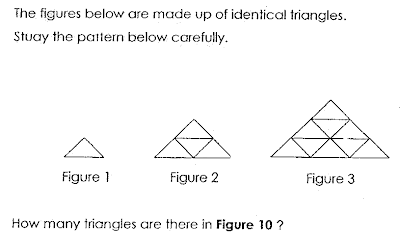

(Pattern Problems – use a table to identify pattern fundamental so as to predict what will come next and what will happen again and again in the same way


a. Complete the table above.
b. How many chairs will there be in Pattern 11?
c. Which pattern will have 192 chairs?

Subscribe to:
Posts (Atom)